


Get
93% Off!
on Lifetime Exclusive Deal
Don’t Miss out this deal, it comes with Password Manager Free of cost.

What are online gaming referral links? A referral link can look like an ordinary URL, but it usually carries a small piece of account context with it. That context is what makes it useful. In online gaming, an invite may connect the sender, the new sign-up, a code, a product area, and a timing condition in one short path. Once you understand that, referral links stop feeling like random bonuses and start looking like structured account signals.

That structure matters because online sharing is rarely just about the click. Research on personal data value and online privacy behavior shows that people often treat their information differently depending on context, perceived control, and what they think the data is worth. Referral links work in that same human space. A user is not only opening a page. They are deciding whether the source, destination, and account action make sense together.
A clear example helps because online gaming platforms often connect several activities under one account. Bovada’s gambling website presents sports betting, casino games, live dealer games, poker, horse betting, crypto options, player points, community features, transaction choices, and a Refer A Friend area, so it gives readers a grounded way to see how an invite can operate inside a wider account journey.
A referral link in this setting is not only a path to registration. It can also help identify who shared the invite, when the new account was created, which offer page introduced the user, and what kind of account action the platform describes as relevant.
That is why Bovada’s gambling website is useful as a practical reference point for understanding online gaming referral links. It means the same account can touch sports, casino, poker, crypto deposits, points, and offer terms, while the referral code remains the connector that ties the invite to the stated process. The main lesson is simple: the link is the beginning of a defined account flow, not the whole story.
To see the account flow written out in a platform-published example, this Refer A Friend page describes a sequence that starts with logging in, moves to the RAF page, and then uses either a referral link or shared code.
It also shows why details matter after the first click: the page connects friend sign-up, a deposit step, poker-point conditions, crypto-related wording, and terms review. Read neutrally, it is a clean demonstration of how referral wording can map to separate stages inside a gaming account.
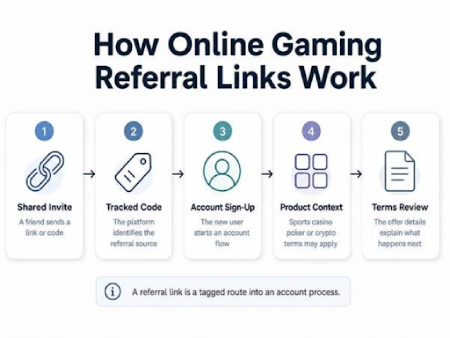
The most useful way to read a referral link is to split it into three layers. The first layer is the visible invite: a URL, code, or button shared by someone else. Its layer is attribution: the platform needs to know which account or code introduced the new user. The third layer is account action: the platform’s offer language explains what has to happen next for the invite to be treated as complete.
| Part of the flow | What it does | Why it matters |
| Referral URL or code | Carries the invite identifier | Connects sender and new sign-up |
| Sign-up page | Creates or starts the account | Makes timing and source traceable |
| Product context | Shows where the offer applies | Keeps sports, casino, poker, or crypto wording clear |
| Terms page | Defines the conditions | Prevents assumptions about how the invite works |
This table is not a technical blueprint. It is a reader’s map. If you know which layer you are looking at, the process becomes easier to understand.
A code is not the same thing as an account. A sign-up is not always the same thing as a completed offer. A product mention, such as poker or crypto, may change how the platform explains the next step.
Referral links are strongest when users treat them with ordinary digital awareness. That does not mean being tense or suspicious. It means noticing the basics: who sent the invite, where the URL goes, whether the page matches the platform, and whether the instructions on the page match what the sender described.
This matters because referral systems sit at the meeting point between social sharing and account creation. A friend may send the invite casually, but the platform page is where the actual conditions live. That distinction keeps the process clear. Friendly context explains why the link was shared. Platform wording explains what the link does. Both routes can be valid when the instructions are clear and current online.
Think of an online gaming referral link as a tagged doorway into a specific account process. The tag identifies the invite. The doorway leads to the platform. The account process decides what happens next. That simple model removes confusion without turning the topic into a dry tutorial.
For readers, the deeper value is not memorizing every possible referral rule. It is learning how to read the path. Look at the source, destination, account step, product context, and terms. The more clearly those pieces line up, the easier it is to understand what the invite is built to do. That wider point is supported by research on privacy nudges and information disclosure, which explores whether timing, presentation, defaults, and information cues can shape how people share personal information online.
Take Control of Your Privacy Today!
Unblock websites, access streaming platforms, and bypass ISP monitoring.
Get FastestVPN
© Copyright 2026 Fastest VPN - All Rights Reserved.
Don’t Miss out this deal, it comes with Password Manager Free of cost.