


Get
93% Off!
on Lifetime Exclusive Deal
Don’t Miss out this deal, it comes with Password Manager Free of cost.

Using a VPN for online gambling can improve connection privacy, but it does not change where a casino is allowed to operate, who is eligible to play, or what information an operator may request before processing a withdrawal.
That distinction matters.
A VPN can hide a public IP address and encrypt internet traffic. It does not make online gambling legal where it is prohibited, and using one to disguise a player’s location may violate a casino’s terms, trigger additional verification, or lead to account restrictions.
It also cannot rewrite a casino’s rules, replace identity verification, or guarantee that an account will remain unrestricted if the operator detects inconsistent location data.
For players, the more useful question is therefore not simply whether a VPN works with an online casino. It is whether VPN use is compatible with the casino’s rules, local regulations, account information, and withdrawal procedures.
A VPN can improve connection privacy, but it does not override casino geo-restrictions, KYC requirements or withdrawal checks.
A virtual private network routes internet traffic through a remote server and changes the public IP address visible to websites.
For readers unfamiliar with the technology, FastestVPN provides a broader explanation of how a VPN works and why people use one.
From a casino’s perspective, a VPN may change the apparent IP location of a connection. It can also encrypt traffic between the player’s device and the VPN server.
What it does not change is equally important.
A VPN does not alter a player’s identity, registered address, payment ownership, KYC documents, casino account history, local gambling laws or the operator’s restricted-country policy.
That difference becomes particularly important when an account reaches the verification or withdrawal stage.
Privacy is one of the most common reasons people use VPNs across the internet.
A player may want to reduce the amount of location information exposed through a public IP address or add encryption while using hotel, airport or other shared Wi-Fi networks.
Travellers may also keep a VPN active for general internet security while abroad.
In other cases, workplaces, universities, hotels or internet providers may apply network-level restrictions to certain categories of websites.
None of these situations automatically means that an online casino permits VPN use.
Players should check both local rules and the operator’s terms before accessing an account. A casino can accept customers from a particular jurisdiction while still prohibiting tools that disguise or alter location information.
Casino geo-blocking is sometimes treated as if it were simply an IP-address problem.
In reality, location restrictions can exist for several reasons.
An operator may exclude a country because of licensing conditions, local gambling laws, payment-provider restrictions, compliance requirements or internal policy.
Changing the IP address seen by a website does not remove those underlying restrictions.
A casino may also compare several pieces of information. The IP address may indicate one location while the account address, phone number, payment method or verification documents indicate another.
CasinoIndex explains this distinction further in its guide to how casino geo-restrictions and restricted-country rules work.
Technical access to a website should therefore not be treated as confirmation that the player is eligible to use the service.
Yes. Changing a public IP address does not make a VPN connection invisible.
Online platforms may use several signals when assessing logins, transactions or unusual account activity.
These can include IP reputation databases, previous connection history, account-location changes, device information and unusual login patterns.
Some services may also identify IP ranges associated with hosting providers or widely used VPN infrastructure.
Players can check the public IP address currently visible to websites with FastestVPN’s What Is My IP tool.
However, a matching IP location does not mean that a casino will automatically consider the player to be located there.
Regulated gambling platforms can use additional geolocation systems. Other operators may perform more detailed checks only after a large transaction, security alert or withdrawal request.
KYC, or Know Your Customer, is separate from the IP address used to access a website.
A casino may request documents or additional information to confirm details such as:
Depending on the operator and jurisdiction, those checks may happen at registration, after certain account thresholds are reached, or when a withdrawal is requested.
This creates an important misconception around VPN use.
A player may technically access a casino through an IP address associated with another country while still being required to provide documents showing their real residence.
If those details conflict with the casino’s eligibility rules, a VPN does not resolve the issue.
Instead, the discrepancy may create another point that the compliance team needs to review.
Depositing money is often one of the simplest parts of the casino account lifecycle.
Withdrawals are different.
Before releasing funds, an operator may review identity, payment ownership, bonus activity, transaction history, account security and location information.
An account can therefore appear to function normally during gameplay but receive additional checks when a payout is requested.
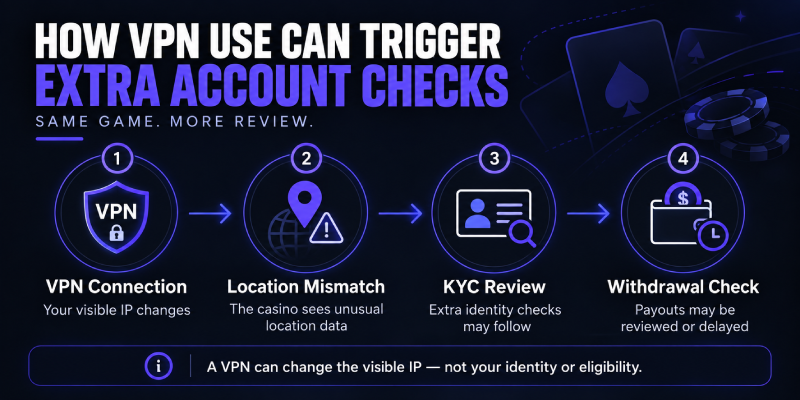
Potential issues can include inconsistent login locations, account details that do not match the detected region, payment methods associated with another country or incomplete identity verification.
This is why withdrawal rules should be understood before depositing. CasinoIndex’s guide to what happens when a casino reviews a withdrawal explains the checks that can become relevant before funds are released.
A VPN does not guarantee faster withdrawals or remove verification requirements.
In some cases, inconsistent location information can result in additional review instead.
Casino policies on VPN use vary considerably.
Some operators explicitly prohibit VPNs, proxies or other IP-masking services.
Others may tolerate VPN connections but still require the player to be physically located in an eligible jurisdiction.
Some terms are less explicit and instead require customers to provide accurate information about their residence and location.
That makes the terms and conditions more important than the technical question of whether the casino website loads while a VPN is active.
Before depositing, players should check:
Restricted countries. Which countries or regions cannot use the service?
VPN and proxy rules. Does the operator explicitly mention IP-masking or anonymisation tools?
Account information. Is the player required to provide an accurate residential address?
Verification. When can the operator request KYC or proof of address?
Withdrawals. Can payouts be delayed while account information is reviewed?
CasinoIndex also examines the risks of using a VPN at an online casino, including the difference between privacy use and using a VPN to present a misleading location.
For players who are permitted to use a VPN and want one primarily for connection privacy, technical reliability matters more than promotional claims.
A dropped connection can interrupt a live casino session, payment page or account login.
Stable performance is therefore more useful than simply looking for the highest advertised speed.
A kill switch can stop internet traffic if the VPN connection unexpectedly fails.
Its main purpose is privacy: it prevents the device from immediately switching back to the normal internet connection.
DNS requests can reveal information about the network being used.
Reliable DNS leak protection helps keep those requests within the intended encrypted connection.
A broad server network can give users more options for obtaining a stable connection close to their actual location.
FastestVPN lists its available VPN server locations.
However, a server location should not be confused with legal or contractual eligibility.
Connecting through a server in another country does not make a player a resident of that country or override a casino’s terms.
Players should also understand what connection or activity data the VPN provider records.
A VPN can improve connection privacy, but the privacy practices of the VPN service itself still matter.
Crypto casinos are often associated with privacy because players can use Bitcoin, stablecoins and other digital assets for deposits and withdrawals.
However, cryptocurrency payments and account verification are separate issues.
A crypto transaction does not automatically mean:
An operator may accept crypto while still applying geographic restrictions, anti-fraud controls and KYC procedures.
This becomes particularly relevant when withdrawals are large, unusual or inconsistent with previous account activity.
Crypto should therefore be viewed as a payment method rather than evidence that location and verification rules no longer apply.
The phrase “VPN-friendly casino” can create false confidence.
It usually means that an operator permits or tolerates VPN connections under certain circumstances.
It does not mean that every country is accepted, that KYC will never apply or that a player can use a VPN to present a false location.
Privacy and eligibility are separate questions.
A VPN can encrypt internet traffic and mask a public IP address. Eligibility still depends on local law, licensing, the operator’s restricted-country policy and the player’s real account information.
This is why a casino may work technically through a VPN while still creating problems later during verification or withdrawal.
If the operator’s VPN policy is unclear, asking support before depositing is safer than discovering the restriction after funds are already held in the account.
The largest problems generally appear when a VPN is used to make account information look different from reality.
For example, a player may connect through one country while providing identity and address documents from another.
That does not automatically mean the account will be restricted, but it creates an inconsistency that the operator may investigate.
Risk increases when a player accesses a casino from an explicitly restricted jurisdiction, provides inaccurate registration information or repeatedly changes apparent locations.
A VPN should also never be used to circumvent self-exclusion, deposit limits, cooling-off periods or other responsible-gambling controls.
Those tools exist to restrict gambling access intentionally. Technical tools should not be used to defeat them.
Before combining a VPN with an online gambling account, players can perform a simple pre-deposit check.
First, confirm that the casino accepts customers from the player’s actual country of residence.
Next, read the sections of the terms covering VPNs, proxies, restricted countries and account eligibility.
Then review the KYC and withdrawal rules.
Finally, make sure that registration information, payment ownership and residency details are accurate.
If an operator prohibits VPN use or excludes the player’s real jurisdiction, the safer choice is not to deposit there.
A VPN can protect an internet connection. It cannot protect a player from breaching an operator’s terms or local rules.
VPN use itself is legal in many jurisdictions, but gambling laws vary by country and region. A VPN does not make gambling legal where it is prohibited. Players should check local rules and the casino’s terms before accessing an account.
They may be able to. Casinos can use IP databases, connection history, location inconsistencies and other account-security signals to identify unusual connections.
Yes. Crypto payments do not remove an operator’s ability to request identity, address, payment-ownership or source-of-funds information.
Potentially. If location data conflicts with account details or the casino’s terms, the operator may perform additional checks before processing a withdrawal.
VPNs can be useful privacy tools for online gambling, particularly when securing connections on shared networks or reducing the amount of location information exposed through a public IP address.
But the technology has clear limits.
A VPN does not replace KYC, change a player’s real residence, override restricted-country rules or guarantee that a withdrawal will be processed without review.
The most important checks therefore happen before the first deposit: confirm eligibility, understand the casino’s VPN policy, review the withdrawal rules and keep all account information accurate.
Used within those boundaries, a VPN remains what it is designed to be: a privacy and security tool rather than a workaround for casino restrictions.
Take Control of Your Privacy Today!
Unblock websites, access streaming platforms, and bypass ISP monitoring.
Get FastestVPN
© Copyright 2026 Fastest VPN - All Rights Reserved.
Don’t Miss out this deal, it comes with Password Manager Free of cost.