You can see how this popup was set up in our step-by-step guide: https://wppopupmaker.com/guides/auto-opening-announcement-popups/
Tralalero Tralala: How an AI-Generated Shark Became a Global Hit
What is tralalero tralala? How did this AI-generated shark in Nike shoes become a global trend overnight? But again, how does anything of little significance become a worldwide trend?
Let’s start with a blunt basic fact that “Tralalero Tralala” doesn’t mean anything. It’s a bunch of created nonsense.
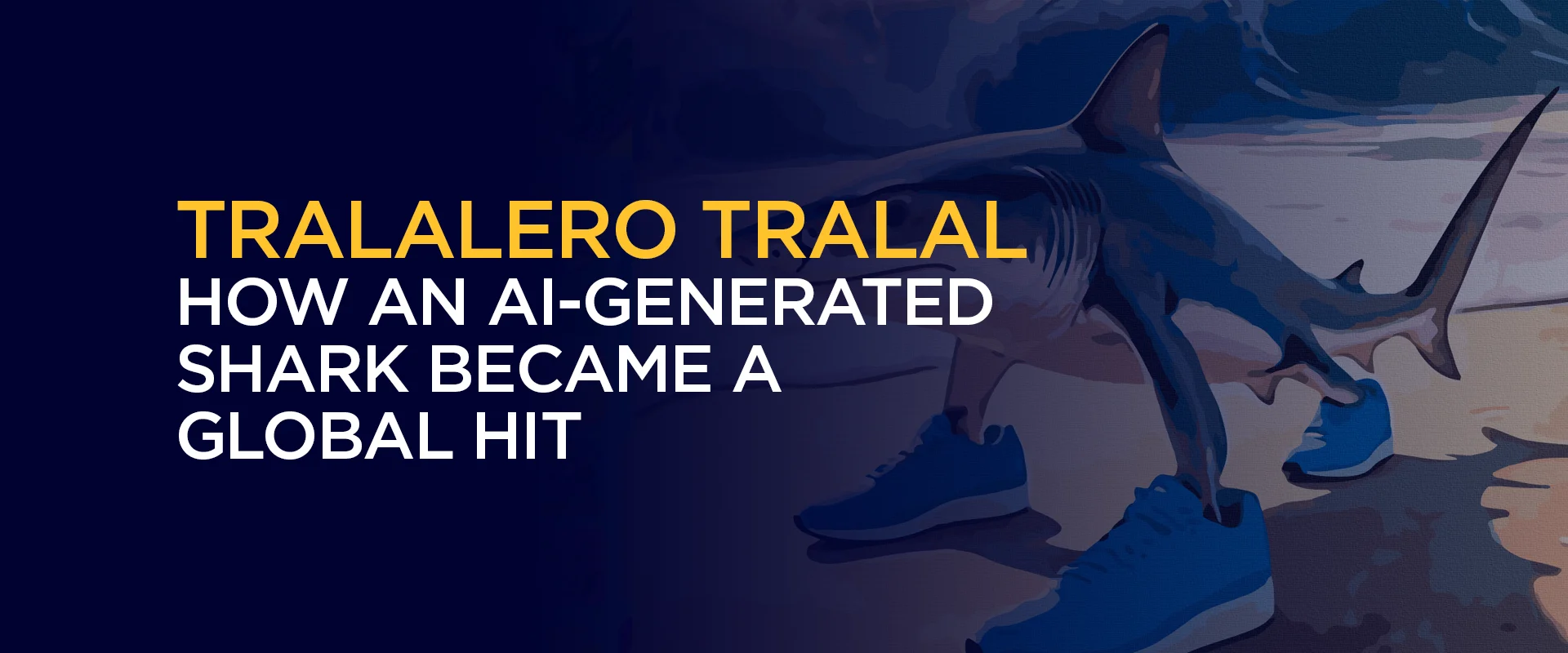
In early 2025, it became somewhat of a battle cry for a bizarre, AI-powered internet takeover. It left parents confused, kids obsessed, and academics scrambling to explain why absurdity sells.
So, how does this walking shark with Nike sneakers represent the next phase of viral culture?
Its Origin – A Banned Audio, A Shark, and the Algorithm
The Tralalero Tralala trend all started in January 2025 on TikTok. A user named @eZburger401 uploaded an AI-generated audio clip, which featured a robotic Italian voice chanting:
“Tralalero Tralala, porco dio e porco Allah… I was with my goddamn kid, playing Fortnite, when my grandma Ornella comes in…”
The audio and the wording itself are profane and arguably offensive. This led to the creator’s account being swiftly banned. However, even if things go up on the internet for a few seconds and then are removed, it still has a way of resurfacing.
A few days later, on January 13th, TikToker @amoamimandy.1a paired that same audio with a low-effort AI image. This image was of a blue shark wearing oversized Nike sneakers, engulfed in a fiery CapCut filter.
The video exploded, generating over 17 million views overnight.
But why? What was it about?
- Nonsense: The audio was catchy but meaningless.
- Surreal: A shark with legs is inherently absurd.
- AI-Generated: It had the signature “uncanny valley” look of early AI art.
This was the birth of Tralalero Tralala.
How an AI Shark Went Beyond Just Being a Meme
Tralalero Tralala wasn’t just a meme; it was a catalyst. It kicked off a wave known as “Italian Brainrot,” an entire cinematic universe of AI-generated creatures with pseudo-Italian names and chaotic rhymes.
It gets worse; the cast expanded rapidly:
- Bombardiro Crocodilo: A military bomber plane with a crocodile head.
- Lirili Larila: A cactus-elephant hybrid walking the desert.
- Brr Brr Patapim: A forest-monkey hybrid with massive feet.
- Ballerina Cappuccina: A ballerina with a coffee cup for a head, created by a 24-year-old in Romania.
Each character followed a similar formula: an animal merged with an object, set to an AI Italian voice spouting religious or nonsensical curses.
The trend quickly transcended borders, spawning Indonesian spin-offs like “Tung Tung Tung Sahur,” which featured a traditional drum.
The Psychology Behind “Brainrot” – Why Does it Work?
The term “brain rot” was Oxford’s “Word of the Year” for 2024. It describes the stupefying effect of scrolling through trivial, unchallenging content. The irony is that creators have now weaponized this concept.
According to researchers, “Italian Brainrot” operates on a principle of “overload opacity.” In plain English, that means:
- Sensory overload: Bright colors, fast cuts, and bizarre imagery flood your brain.
- Interpretive resistance: The content doesn’t mean anything, so you can’t easily categorize it.
- Algorithmic reward: The chaos keeps you watching, which makes the algorithm push it to more people.
As one academic notes, these memes achieve “hypervisibility while resisting interpretive legibility.” It gives you a feeling of “It’s complete crap, but you can’t look away, and you can’t quite explain why.”
The Rise of AI Slop and The Economy of Nonsense
Tralalero Tralala opened the door for what is now called “AI slop.” What is it? It’s cheap, fast, low-quality AI content designed purely for engagement.
This has created a new digital economy, and here’s how:
- Merchandise: In Japan, stores sell keychains and toys of Tralalero Tralala and Ballerina Cappuccina.
- Viral goldmines: A YouTube Short teaching how to draw these characters has over 320 million views. It’s one of the most happening engagements lately, especially for young teens.
- Content farming: Creators are making millions by mass-producing AI videos. One AI slop channel, Bandar Apna Dost, has over 2.07 billion views and earns an estimated $4 million a year.
The creator of the original “Tung Tung Tung Sahur” character, an Indonesian teenager, is now represented by a Paris-based art collective.
He told them: “I didn’t want my character to be just another passing joke. I wanted him to have meaning.”
So, where does the problem lie? That meaning is easily lost. One 12-year-old tourist in Tokyo thought the “Tung Tung Tung Sahur” drum was a baseball bat. With that said, the generation gap is real.
Tralalero Tralala – Offensive Content and Parental Blind Spots
While many see this as harmless fun, psychologists are worried. Clinical psychologist Oriza Sativa notes that these characters are increasingly inserted into “adult content.” It includes videos with offensive messages that reference real-world tragedies.
“The problem is that these characters are put into adult content… many parents are not tech-savvy enough to spot the dangers.” – Oriza Sativa.
However, because the content is dressed in kid-friendly visuals, like sharks, cappuccinos, bright colors, etc., it slips past parental filters. Most parents overlook what their kids are watching.
Kids nowadays are always watching violent or racist content without understanding the context, simply because a funny shark is on screen.
How Does Tralalero Tralala Affect the Future of the Internet?
Tralalero Tralala is more than a meme; it’s proof of concept for a new era of AI-driven media. Here’s how it kills the future of the internet:
- There’s no required barrier: anyone can now generate and push viral content with a few AI prompts. The skill barrier has completely vanished.
- Authenticity is dead: the space for AI slop is now massive, and platforms like TikTok and Instagram are filled with content that users know is fake. But they watch it anyway, pushing it to hit more viewers.
- The race to the bottom: creators are quickly descending into increasingly extreme content to retain views. This is a cycle that degrades rapidly over time.
As the BBC recently reported, social media has entered its “third phase,” dominated not by friends or creators, but by AI-generated content. Sadly, this isn’t a bug; it’s a feature.
To Conclude
Tralalero Tralala started off as a simple banned, nonsensical audio clip and became the face of a global movement. It gave birth to a universe of absurd characters, a new economy of AI slop, and a generation of kids who are more comfortable with AI-generated sharks than their parents are with the concept of brain rot.
Take Control of Your Privacy Today! Unblock websites, access streaming platforms, and bypass ISP monitoring.
Get FastestVPN
Subscribe
0 Comments