You can see how this popup was set up in our step-by-step guide: https://wppopupmaker.com/guides/auto-opening-announcement-popups/
VPN Concentrator vs Firewall: Key Differences, Use Cases, and Enterprise Deployment Guide
In the modern era of remote work, distributed branch offices, and cloud-first infrastructures, securing corporate networks has never been more critical. As organizations scale their networks to accommodate remote employees, network architects frequently encounter a fundamental design dilemma: VPN concentrator vs firewall. While both are essential pillars of perimeter security and remote access, they serve entirely different primary functions within the OSI model and network topology.
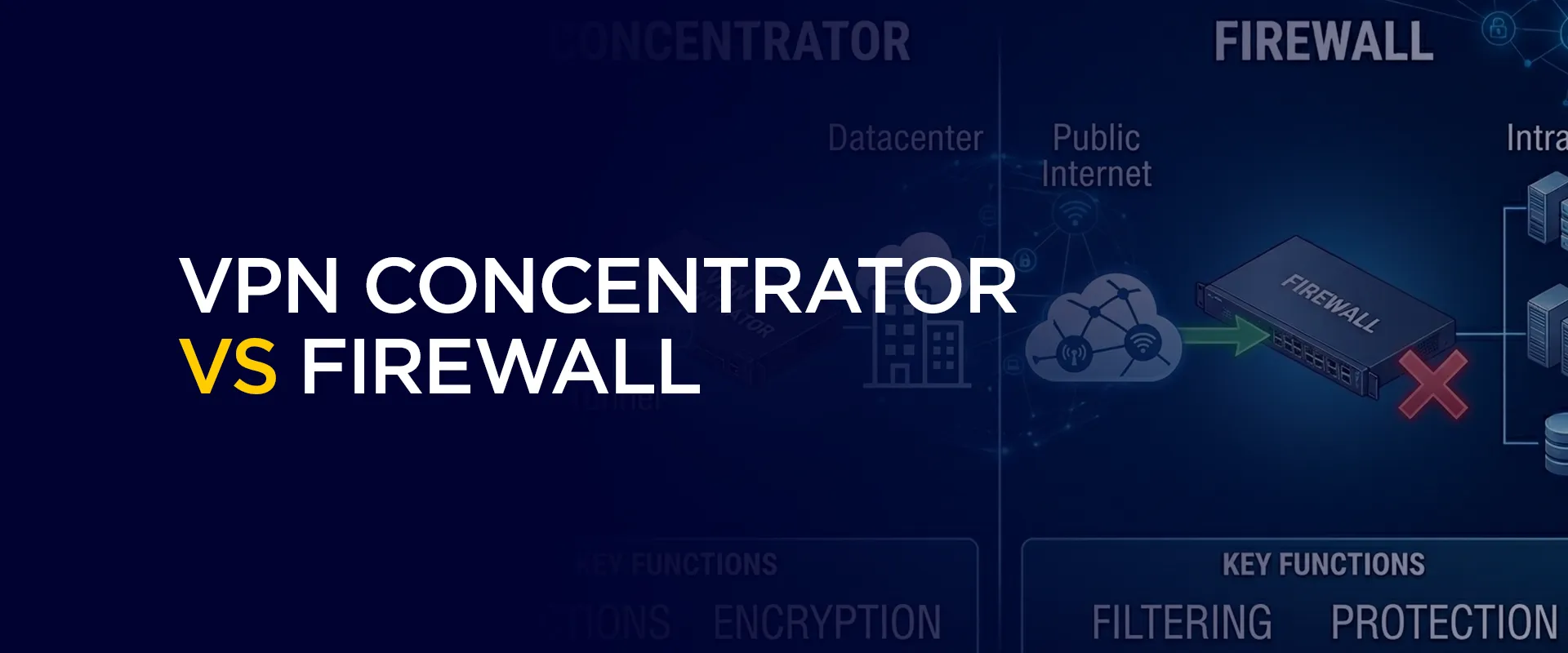
A fundamentally misunderstood concept in networking is the functional overlap between these two devices. Because modern Next-Generation Firewalls (NGFWs) come equipped with built-in Virtual Private Network (VPN) capabilities, many IT professionals mistakenly assume that dedicated VPN concentrators are obsolete. However, relying solely on a firewall to manage thousands of encrypted tunnels can lead to severe performance bottlenecks, latency issues, and compromised security postures.
In this comprehensive, expert-driven guide, we will dissect the semantic entities of VPN concentrators and network firewalls. We will explore their core functionalities, their processing architectures, and precisely when your enterprise should deploy a dedicated VPN concentrator versus relying on a robust firewall.
Understanding the Entities: Definitions and Core Functions
What is a VPN Concentrator?
A VPN concentrator is a dedicated networking device—available as either proprietary hardware or a virtualized software appliance—specifically engineered to create, manage, and terminate multiple secure VPN tunnels simultaneously. It acts as the centralized aggregation point for remote access VPNs and site-to-site VPN connections, making it easier for distributed teams to send large files for free through a secure, encrypted tunnel.
Unlike a standard VPN router, which might handle a few dozen connections, a high-grade VPN concentrator is equipped with specialized cryptographic hardware accelerators. These allow the device to perform the mathematically intensive encryption and decryption processes (such as IPsec or SSL/TLS) at wire-speed for thousands of concurrent users without degrading network throughput.
Core Capabilities of a VPN Concentrator:
- High-Volume Tunnel Management: Capable of authenticating and routing traffic for thousands of concurrent remote endpoints.
- Cryptographic Acceleration: Offloads the heavy CPU burden of cryptographic algorithms (AES-256, RSA) from standard network routers.
- Advanced Authentication: Integrates seamlessly with RADIUS, TACACS+, LDAP, and Multi-Factor Authentication (MFA) protocols to verify user identities.
- Endpoint Posture Checking: Verifies the security state of an incoming device (e.g., checking for updated antivirus software) before granting network access.
What is a Network Firewall?
A firewall is a fundamental network security system that monitors, filters, and controls incoming and outgoing network traffic based on predetermined security rules and policies. While early firewalls operated simply as packet filters at Layer 3 (Network) and Layer 4 (Transport) of the OSI model, modern Next-Generation Firewalls (NGFWs) operate all the way up to Layer 7 (Application).
The firewall’s primary mandate is to establish a barrier between a trusted, secure internal network and another outside network, such as the public Internet. It inspects traffic for malicious payloads, enforces access control lists (ACLs), and provides intrusion prevention.
Core Capabilities of a Network Firewall:
- Stateful Packet Inspection (SPI): Tracks the operating state and characteristics of network connections passing through it.
- Deep Packet Inspection (DPI): Analyzes the actual data payload of a packet to detect malware, viruses, and policy violations, including those associated with social security scams.
- Intrusion Detection and Prevention (IDS/IPS): Identifies and actively blocks vulnerability exploits and anomalous traffic patterns.
- Application Awareness: Identifies and controls applications regardless of port, protocol, or evasive tactics.
VPN Concentrator vs Firewall: The Core Differences Explained
To architect a resilient and highly available network, it is crucial to understand where these technologies diverge. Below is a deep dive into the primary differences between a VPN concentrator and a network firewall.
1. Primary Purpose and Design Philosophy
The most defining difference lies in their primary objectives. A firewall is a defensive mechanism. Its job is to scrutinize, block, or permit traffic based on a zero-trust or least-privilege philosophy. It is constantly asking, ‘Is this traffic safe, and is it allowed?’
Conversely, a VPN concentrator is a connectivity and privacy mechanism. Its primary objective is encapsulation and encryption. It is designed to securely transport data across an untrusted network (the Internet) by creating a secure tunnel. It asks, ‘Who is this user, and how fast can I encrypt/decrypt their data payload?’
2. Processing Power and Hardware Architecture
Encryption and decryption are incredibly taxing on a CPU. A dedicated VPN concentrator is purpose-built with Application-Specific Integrated Circuits (ASICs) optimized purely for cryptographic math. When thousands of employees log in simultaneously at 9:00 AM, the VPN concentrator absorbs the cryptographic load effortlessly.
When a firewall is forced to handle heavy VPN traffic alongside its primary duties, it experiences resource contention. Performing Deep Packet Inspection, malware scanning, and managing IPS rules already consumes massive amounts of CPU and memory. Forcing that same CPU to simultaneously terminate thousands of IPsec tunnels can cause the firewall’s throughput to plummet, leading to network-wide latency and degraded internet speeds for users trying to stream the best movies on Netflix right now during their downtime.
3. OSI Model Operations
Understanding the OSI (Open Systems Interconnection) model context is crucial for semantic SEO and technical clarity:
- Firewalls primarily operate at Layer 3 (routing/IP), Layer 4 (TCP/UDP ports), and Layer 7 (application-level inspection). They analyze the headers and payloads of unencrypted traffic (or traffic they have decrypted via SSL inspection) to enforce security policies.
- VPN Concentrators operate at Layer 2 (L2TP, PPTP), Layer 3 (IPsec), or Layer 7 (SSL/TLS VPNs). Their job is to take an entire IP packet, encapsulate it, encrypt it, and send it out. They generally do not inspect the contents of the payload for malware; they only care about securely delivering the payload from point A to point B.
4. Traffic Direction and Network Placement
Firewalls are strategically placed at the network perimeter (edge) or between internal network segments (internal segmentation firewalls) to act as chokepoints for all north-south and east-west traffic.
VPN concentrators are typically placed behind the perimeter firewall or in the network’s Demilitarized Zone (DMZ). The external firewall permits encrypted VPN traffic (e.g., UDP port 500 for IPsec) to pass through to the concentrator. Once the concentrator decrypts the traffic, it is often routed back through an internal firewall interface so that the newly unencrypted traffic can be inspected before it reaches sensitive internal servers.
The NGFW Dilemma: Do You Need Both?
Because modern enterprise Next-Generation Firewalls (like Palo Alto, Fortinet, and Cisco Firepower) include robust VPN capabilities, many IT directors ask: ‘Why buy a separate VPN concentrator if my firewall already does VPN?’
The answer depends entirely on scale and performance.
Scenario A: Small to Medium Businesses (SMBs)
For an organization with 50 to 200 remote employees, a robust NGFW is usually sufficient. The firewall’s CPU can handle the moderate cryptographic load without sacrificing its ability to perform IPS and packet inspection. Purchasing a dedicated VPN concentrator here would be an unnecessary capital expenditure (CapEx).
Scenario B: Large Enterprises and High-Volume Remote Workforces
For a multinational corporation with 5,000+ remote workers, relying on a firewall to terminate VPNs is a recipe for disaster. The sheer volume of encrypted traffic will cause the firewall’s CPU to spike to 100%, leading to dropped packets and network outages. In this scenario, deploying a dedicated VPN concentrator (or a clustered pair for high availability) is strictly necessary to offload the encryption burden, allowing the firewall to focus solely on threat detection and policy enforcement.
Frequently Asked Questions (FAQ)
Can a firewall act as a VPN concentrator?
Yes. Most modern Next-Generation Firewalls (NGFWs) have built-in VPN server capabilities that allow them to terminate remote access and site-to-site VPNs. However, they are not dedicated VPN concentrators, meaning their hardware resources must be split between threat inspection and encryption. They are suitable for low-to-moderate VPN traffic but may struggle under enterprise-level loads.
Do I need both a VPN concentrator and a firewall?
You absolutely need a firewall to protect your network from external threats. Whether you also need a VPN concentrator depends on the size of your remote workforce. If you have thousands of remote users connecting simultaneously, you should deploy both: use the concentrator to handle the encryption load and the firewall to inspect the decrypted traffic.
What is the difference between a VPN router and a VPN concentrator?
A VPN router is a standard network routing device that includes basic VPN features, typically suitable for small branch offices or home networks managing a handful of tunnels. A VPN concentrator is an enterprise-grade appliance built specifically for high availability, advanced authentication, and managing thousands of concurrent, heavily encrypted tunnels.
Is a VPN Concentrator part of a SASE or Zero Trust architecture?
While VPN concentrators provide secure remote access, modern Zero Trust Network Access (ZTNA) and Secure Access Service Edge (SASE) frameworks are actively evolving beyond traditional VPNs. ZTNA connects users directly to specific applications rather than granting broad network access via a concentrator, representing the next evolution in remote security.
Conclusion
In the debate of vpn concentrator vs firewall, it is clear that these are not competing technologies, but highly complementary ones. A firewall is your network’s ultimate gatekeeper and defense mechanism, relentlessly analyzing traffic for threats and enforcing corporate access policies. A VPN concentrator is your high-speed, cryptographic transit authority, ensuring that thousands of remote employees can communicate securely without bogging down your defensive infrastructure.
For small businesses, converging these functions into a single Next-Generation Firewall is a cost-effective and practical choice. However, as your organization scales, separating these entities ensures maximum network throughput, reduced latency, and a much stronger overall security posture. By understanding the distinct roles each appliance plays, network engineers can build resilient architectures capable of supporting the modern, hybrid workforce.
Take Control of Your Privacy Today! Unblock websites, access streaming platforms, and bypass ISP monitoring.
Get FastestVPN Subscribe
0 Comments